
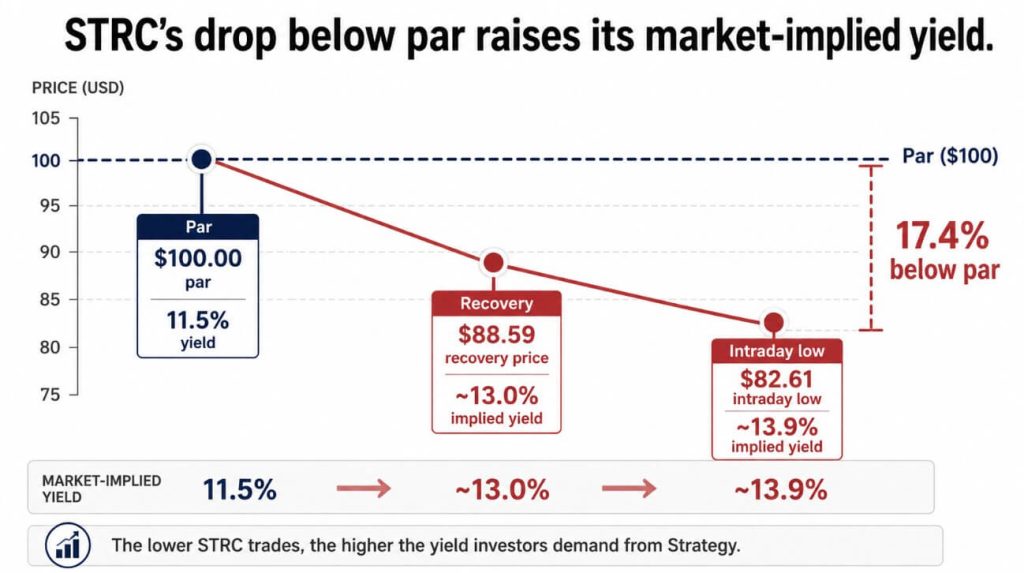
STRC, Strategy’s perpetual preferred stock, traded as low as $82.61 on June 18 before recovering to $88.59, putting the security nearly 17% below its $100 stated amount at the intraday low.
MSTR fell 3.4% to $112.53 during the same session, while Bitcoin traded near $62,730, down about 2.5%.
Strategy designed STRC to hover around $100 through monthly dividend-rate adjustments, currently set at 11.50% annualized, payable semi-monthly in cash.
At $88.59, that 11.5% coupon implies an effective yield of roughly 13.0%, and the disconnect between the stated rate and market demand shows how far confidence has slipped.
With approximately $10.5 billion of STRC notional outstanding, an 11.5% annual rate implies roughly $1.21 billion in STRC-only dividend costs.
If the market keeps pricing below par and Strategy responds by raising the rate to 14%, the cost would rise to about $1.47 billion annually, which is a dynamic that critics have been warning about for months.
What the criticism got right
The Ponzi-like characterization of STRC has circulated widely, with Peter Schiff calling it “the most obvious Ponzi” and arguing that new capital fund payments go to existing holders.
Strategy’s filings describe STRC as perpetual preferred equity with disclosed risks and discretionary dividend mechanics. The company has no legal obligation to maintain STRC near $100, and its own prospectus warns that raising the dividend when STRC trades below par may fail to restore the price.
Tyler Wellener, CSO at Tyr Capital, commented on the structural problem in a note:
“The capital structure has become more complex over the last year, and the market is nervous about their ability to keep everyone happy and fulfill the obligations.”
He added that STRC is a confidence game in management, as it is not really backed or collateralized by Bitcoin. A 2.5% Bitcoin drawdown produced a 17% intraday swing in STRC because the instrument’s stability depends on continuous confidence in Saylor’s capital allocation.
Ryan Haczynski, head of protocol partnerships at GlobalStake, identifies a second accelerant. On-chain STRC derivatives and tokenized share products had been purchasing and tokenizing shares, while larger participants had built large short positions.
As STRC spent months trading close to par, investors treated it as a low-volatility carry and added leverage to enhance yield.
When the price slipped below key levels, margin calls triggered a cascade of liquidations, amplifying the move.
Haczynski also notes that Saylor recently acknowledged ChatGPT played a role in developing the STRC structure, a detail that compounded selling pressure as the clip circulated alongside the price decline.
Why selling Bitcoin does not fix this
Strategy disclosed that it sold 32 BTC between May 26 and May 31 for $2.5 million, with the proceeds expected to fund preferred stock distributions.
The company subsequently bought 1,550 BTC for $101.3 million, bringing total holdings to 845,256 BTC as of June 7 and raising its US dollar reserve to $1 billion.
The 32 BTC sale was financially negligible, roughly 482 times smaller than one year of STRC-only dividends at the current rate, but it cracked the narrative that Saylor would never sell.
Wellener addressed the BTC sale question:
“Selling BTC will weaken their balance sheet and spook the market as large BTC holders may look to sell their BTC to de-risk, and common equity holders may realize they’re better off holding BTC directly or buying one of the ETFs.”
MSTR shareholders bought the stock to accumulate Bitcoin per share, while STRC holders bought it for yield. Selling Bitcoin to fund dividends appeases one constituency while alarming the other, and does nothing to address whether Strategy can generate yield without continuously refinancing through new capital.
Haczynski said that Strategy’s likely next move involves some combination of a higher dividend rate, opportunistic buybacks of discounted STRC shares, or additional capital raises using MSTR or traditional debt.
Raising the dividend increases the annual burden and gives ammunition to critics who warn of a feedback loop. MSTR issuance preserves the Bitcoin stack but dilutes common shareholders and reduces BTC-per-share accretion, the core metric that MSTR buyers care about.
A buyback would be the strongest confidence signal, since repurchasing STRC at a steep discount and reissuing it closer to par could be accretive to MSTR shareholders, but it consumes cash that could otherwise fund dividends or buy Bitcoin.
| Rescue option | How it helps STRC | Tradeoff | Who takes the pain |
|---|---|---|---|
| Raise STRC dividend | Narrows the gap between stated payout and market yield | Raises annual cash burden and feeds feedback-loop concerns | Strategy balance sheet |
| Sell Bitcoin | Provides cash for preferred distributions | Weakens the “never sell” accumulation narrative | MSTR holders / BTC bulls |
| Issue MSTR stock | Preserves Bitcoin holdings while raising cash | Dilutes common shareholders and BTC-per-share accretion | MSTR holders |
| Buy back STRC | Signals confidence and captures discount to par | Uses cash that could fund dividends or BTC purchases | Strategy liquidity |
| Let STRC reprice | Avoids throwing capital at market support | Admits STRC may trade like distressed Bitcoin credit | STRC holders / reputation |
Wellener shared what a credible fix requires:
“Strategy’s ability to right the ship will come down to if they can convince the market they can increase BTC per share without relying on equity issuance or financial engineering.”
He added that moving beyond buy-and-hold to use derivatives for yield generation, as commodity firms have done for two decades, could provide a path to real yield that does not depend on capital-market access or Bitcoin price appreciation.
What the market prices next
If Strategy announces buybacks, raises its US dollar reserve, or outlines a credible derivatives-based yield strategy, STRC can recover toward the $95-$100 range.
Haczynski described the move as a liquidity unwind: the company held $1 billion in USD reserves as of June 7 against a quarterly STRC dividend obligation of roughly one-quarter of $1.21 billion.
A well-structured buyback at current prices would be accretive and would demonstrate that the $100 par target is more than a marketing claim.
If STRC holds below $90 and the market begins pricing a 14% effective yield as the new baseline, the feedback loop the critics described becomes self-reinforcing.
Dividend hikes increase the cash burden without restoring par, MSTR issuance to fund those hikes dilutes common holders, and Bitcoin sales to cover shortfalls undermine the accumulation thesis.
The instrument reprices as distressed Bitcoin credit, with different investor expectations, different buyer bases, and a much higher bar for confidence recovery.
| Scenario | Trigger | STRC impact | Broader market implication |
|---|---|---|---|
| Confidence repair | Buybacks, higher USD reserve, credible yield strategy | STRC moves back toward $95–$100 | Market treats the plunge as a liquidity event |
| Controlled repricing | STRC stabilizes below par but dividends remain credible | STRC trades as high-yield Bitcoin-linked preferred | Investors demand higher compensation but avoid panic |
| Yield spiral | STRC stays below $90 and Strategy raises payout repeatedly | Cash burden rises without restoring par | Criticism of the structure intensifies |
| BTC-sale backlash | Strategy sells more Bitcoin to fund distributions | STRC may get payment support, but MSTR weakens | Accumulation narrative breaks further |
| Sector repricing | Investors question Bitcoin-based yield products broadly | STRC becomes the cautionary case | Future BTC treasury products face higher collateral and yield scrutiny |
The broader implication extends beyond Strategy, as Bitcoin-based yield products are being stress-tested at scale as credit instruments for the first time.
If STRC cannot hold par with an 11.5% dividend, a $10.4 billion notional base, and 845,256 Bitcoin on the balance sheet, the next generation of Bitcoin treasury products will face harder questions about collateral structures, yield sustainability, and what it means to offer yield backed by a non-yielding asset.
The post STRC’s plunge puts Saylor’s Bitcoin dividend machine under pressure appeared first on CryptoSlate.